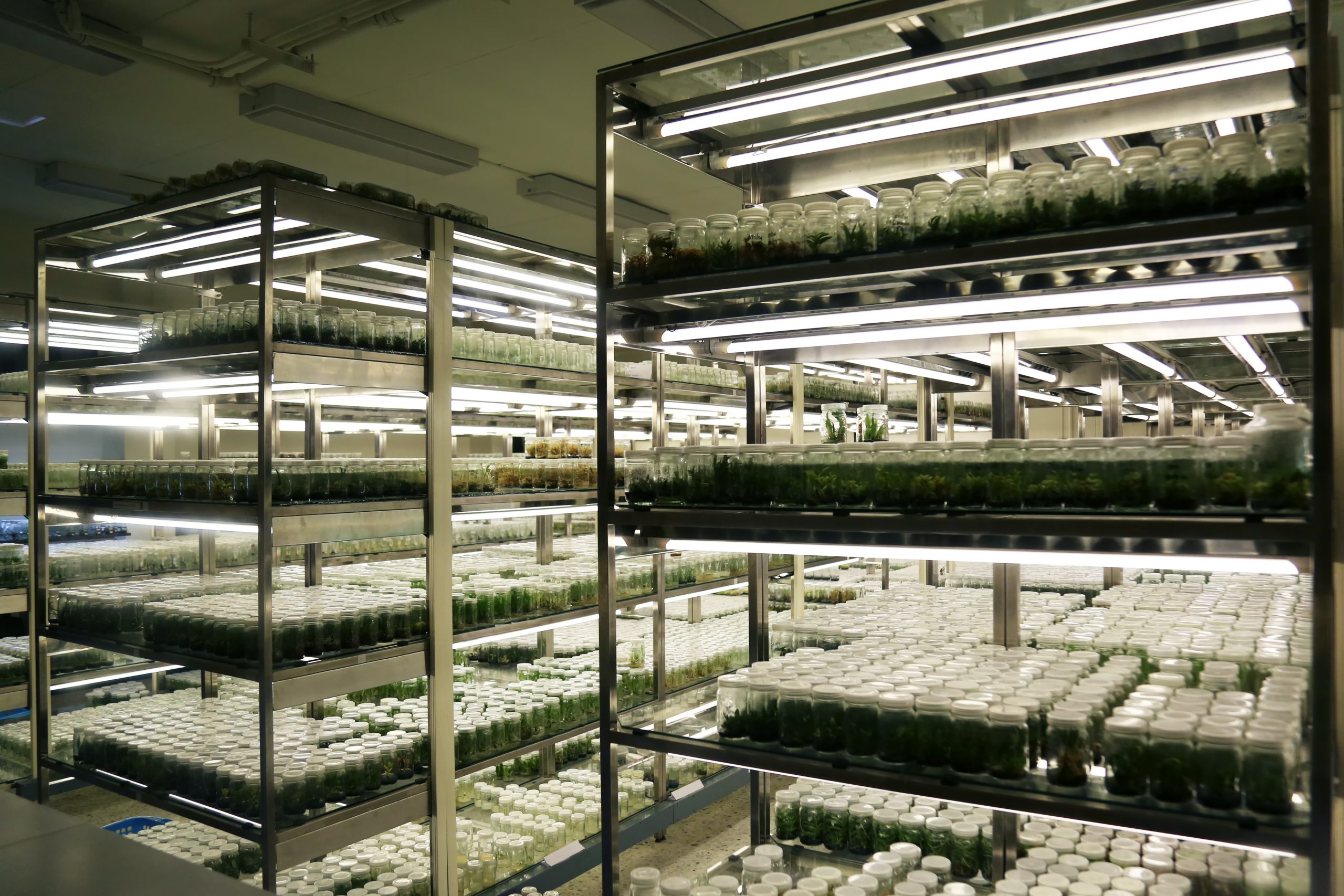
If you’ve bought plants online in India recently, you’ve likely seen “TC” or “tissue culture” next to certain listings — often with a higher price tag. Here’s what it actually means and why it matters.
What Tissue Culture Is
Tissue culture (TC) is a method of propagating plants in a sterile laboratory environment rather than in soil. A tiny piece of plant material — a shoot tip, a leaf section, a node — is placed onto a nutrient gel (called culture medium) under completely sterile conditions. The plant tissue grows and multiplies in this controlled environment, producing hundreds or thousands of genetically identical plants from a single parent.
The process happens in sealed flasks or culture vessels inside a laminar flow cabinet — a filtered air workstation that keeps bacteria and fungi out. Everything that touches the plant tissue has been autoclaved or sterilised with alcohol and flame.
Why It’s Different from Conventional Propagation
Conventional plant propagation — cuttings, division, seed — happens in soil or open air. This means:
- Exposure to soil-borne pathogens (fungi, bacteria, nematodes)
- Variation between plants (especially from seed)
- Slow scaling — you’re limited by how much material the parent plant can provide
- Seasonal constraints
TC bypasses all of these. Plants produced in culture are:
- Pathogen-free — never exposed to soil organisms
- Genetically uniform — clones of the parent
- Year-round — not seasonally dependent
- Scalable — multiplication happens exponentially in culture
The Acclimatization Step
There’s an important caveat: TC plants come out of the lab in a near-sterile, high-humidity, low-light environment. They are physiologically different from plants grown in normal conditions — their waxy cuticle is thinner, their stomata don’t close efficiently, and they have little to no resistance to the microbes present in normal soil and air.
This means TC plants must be acclimatized gradually when they leave the lab. This process — often called “weaning” or “hardening off” — involves moving plants from high humidity to ambient conditions slowly over several weeks. Done correctly, the success rate is very high. Done carelessly, losses can be significant.
All TC plants from our nursery are hardened off before shipping, reducing this risk considerably.
Why TC Plants Cost More
The lab infrastructure, media preparation, sterilisation, and skilled labour involved in TC production are genuinely more expensive than conventional propagation. When you pay a premium for a TC plant, you’re paying for:
- Disease-free status
- Genetic consistency
- Controlled, documented production
For rare or high-value varieties, TC is often the only way to get consistent, available supply at all.