Description
🌿 Musa acuminata — the wild ancestor of the edible banana and the source of the ‘A’ genome. Offered as an in-vitro culture, one multiplying clump per vessel, in two forms: Standard (plain green) and Variegated (cream-and-green chimeral foliage).
🍌 About this banana
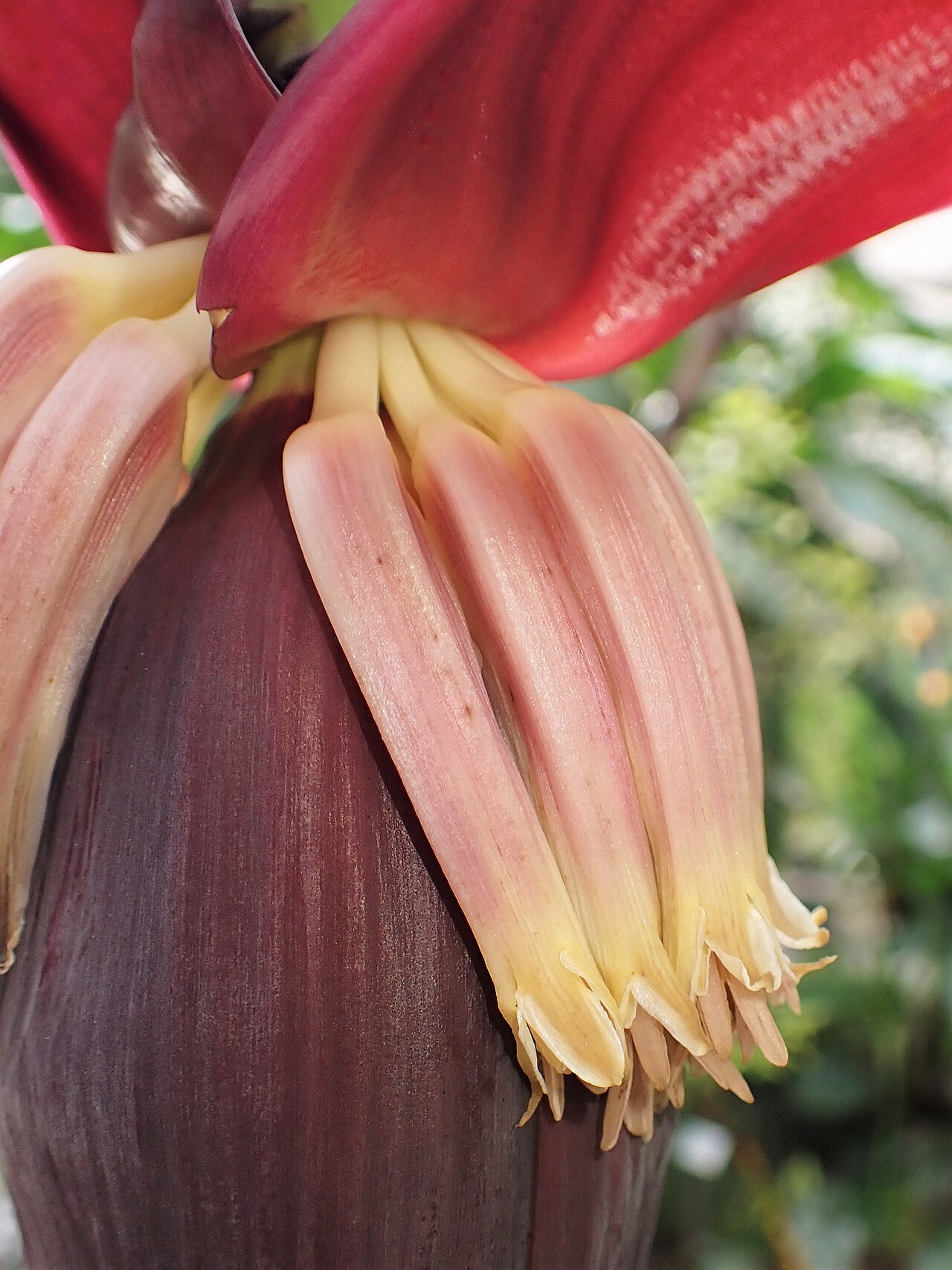
Musa acuminata is the primary wild ancestor of almost every edible banana on Earth — the source of the ‘A’ genome. Wild forms make a slender 2.5–4 m pseudostem, upright then arching leaves, and a pendent inflorescence with a deep red-purple bell. The type is grown as an ornamental, a breeding parent and a rootstock-quality clean line.
The Variegated form carries a chimeral mutation that streaks and blocks the leaves (and often the fruit skin) in cream-white and green. It is one of the most sought-after ornamental bananas. Because the variegation is an unstable chimera, in-vitro plantlets vary in the amount of white they carry and some revert to plain green — this is normal for variegated Musa and is priced accordingly.
🧬 Genome group & background
Wild diploid species, genome AA, section Musa. Non-commercial as fruit; grown as an ornamental, a breeding parent and a clean reference line.
✨ Why buy it as a culture
- 🧬 True ‘A’-genome reference material for breeding and teaching
- 🌱 Standard form: vigorous, clean, seed-true wild type
- 🎨 Variegated form: a high-value ornamental almost never offered in India as clean stock
- 🦠 Pathogen-indexed at supply — safe to bring into a collection or lab
- ♻️ Multiplies quickly from one clump for your own scale-up
📊 Culture specification
| Culture detail | Specification |
|---|---|
| Format | Sealed sterile culture vessel |
| Contents | 1 multiplying clump — one clump per culture |
| Stage | Stage II — shoot multiplication |
| Medium | MS basal + BAP cytokinin, 0.7% agar |
| Incubation | 25 ± 2 °C, 16 h photoperiod, ~40 µmol m⁻² s⁻¹ |
| True-to-type | Clonal from an indexed mother line |
| Recommended climate | Warm, bright, humid; 22–34 °C. Variegated form needs high light but shade from harsh midday sun to avoid scorch on white tissue |
🎨 A note on the Variegated form
Variegation in Musa is a chimeral trait. Tissue culture can carry it but not perfectly — expect variation in pattern between plantlets and a proportion that revert to green as they grow on. Grow in bright light, keep the plant actively growing, and rogue out fully-green or fully-white shoots to keep the line stable. Variegated vessels are selected for visible variegation at dispatch but no fixed ratio is guaranteed.
🌱 De-flasking & hardening (for the buyer)
- 🧫 On arrival: keep the vessel upright, at 24–28 °C, in bright diffuse light for 3–5 days to recover from transit
- 🪝 Sub-culture onto fresh multiplication medium in a laminar hood, or move rooted shoots to a rooting medium (½ MS + 1 mg/L IBA)
- 💧 Primary hardening: rinse agar off rooted plantlets, plant into sterile coco-peat : perlite (3:1), 90–95% RH under a humidity dome, 25–30 °C
- 🌬️ Step-down humidity over 2–3 weeks; then pot on and grow in 50% shade before field planting
- 🧴 No fertiliser for the first 10 days; then quarter-strength balanced feed
📦 What you will receive
- 1 sealed sterile culture vessel — one multiplying clump, in the Form you select
- Standard: plain-green shoots from the wild-type line
- Variegated: shoots selected for visible cream-and-green variegation (pattern varies; some reversion is normal)
- Mother-line reference label, batch code and printed hardening protocol
🚚 Dispatch & policy
🇮🇳 Cultures ship across India in insulated, cushioned packaging. Prepaid orders only. Each culture is produced to order from a maintained mother line, so allow 2–4 weeks for a clean, contamination-checked vessel to be ready. Living in-vitro material is perishable and cannot be returned; on the rare event of transit contamination or damage, send photos within 24 hours of delivery for a replacement. We pause dispatch during peak monsoon (December–January).
Reviews
There are no reviews yet.