If you’ve spent any time asking around about tissue culture plants in India, you’ve almost certainly heard something discouraging. That they’re weak. That they’re pumped with hormones. That they’ll die within a season. That conventional nursery plants are more reliable.
Most of this is simply not true, and some of it is actively misleading. The reality of tissue culture propagation — what it actually is, what it produces, and why institutions from the Indian Council of Agricultural Research to horticultural departments across every state government have adopted it as their standard method — is considerably more interesting and considerably more reassuring than the rumours suggest.
What Tissue Culture Actually Is
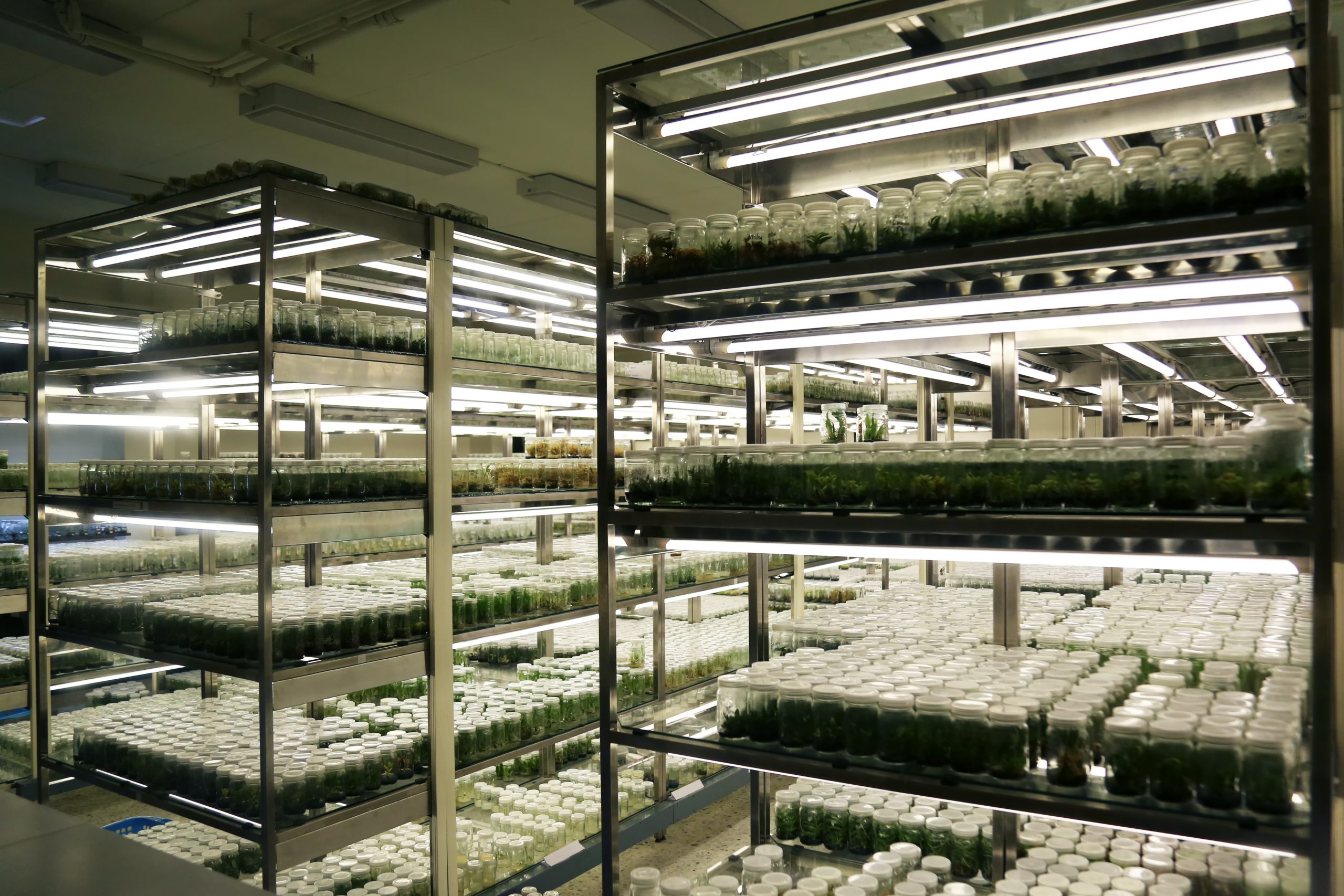
Tissue culture — or micropropagation — is the process of growing a new plant from a tiny fragment of a parent plant: a shoot tip, a leaf segment, a node. That fragment is placed into a sterile glass vessel with a precisely formulated nutrient medium and allowed to multiply in a controlled environment. The result is a clone of the parent — genetically identical, disease-free, and produced at a scale that conventional propagation simply cannot match.
The key word is sterile. Every stage of tissue culture happens in conditions where no bacteria, no fungi, no nematodes, and no viruses can be present. The medium is autoclaved. The vessels are sealed. Technicians work in laminar flow cabinets with filtered air. The plant that comes out of this process has never encountered soil, never been exposed to the pathogens that routinely colonise conventionally grown nursery stock. It is, by any reasonable measure, the cleanest possible way to start a plant.
The “Chemical-Soaked” Myth, Examined Honestly
One of the most persistent criticisms of TC plants is that they’re full of chemicals — specifically the plant growth regulators used during propagation. This deserves a direct response.
Yes, tissue culture uses plant growth regulators. These are compounds — cytokinins, auxins, gibberellins — that occur naturally in plants, used in trace quantities to direct the plant’s development at specific stages. They’re measured in milligrams per litre, inside a sealed vessel.
Before a TC plant is potted and dispatched to you, it goes through hardening — acclimatisation to normal conditions. During this process, it’s grown in substrate without any growth regulators. The trace amounts that were in the medium wash out rapidly. By the time a properly hardened TC plant reaches a grower, the PGR levels in its tissue are no different from those in any conventionally grown plant — because the plant itself is now producing its own hormones in its own balance.
Gas chromatography analysis of hardened TC plants consistently shows no meaningful residual PGR concentration above background plant levels. The plants are not chemically different. They’re different in being cleaner — free of the biological load that field soil carries.
What Conventional Propagation Carries That TC Does Not
Conventional nursery plants are grown in soil — often soil reused across multiple seasons, in facilities with varying sanitation standards. Field soil contains beneficial organisms, but it also contains fusarium fungi, pythium, phytophthora, bacterial wilts, nematodes, and viruses. Some of these are immediately obvious. Many are not.
A banana cutting from a conventional nursery looks healthy. But fusarium wilt — the fungal disease devastating banana cultivation across Asia and spreading through India — can be present in the rhizome without any visible symptoms. By the time symptoms appear, the infection is established and the soil around it is contaminated.
A tissue culture banana plant cannot carry fusarium in its rhizome. It’s never been in contact with field soil. This isn’t a minor advantage — it’s a fundamental difference in disease risk, verified by decades of agricultural data across India and internationally.
Why Hardened TC Plants Establish Faster
The one genuine adjustment period for TC plants is the transition from a controlled lab environment to the outdoor world. In the lab, humidity is high, light is gentle and consistent, temperature is stable. A plant going from that environment to a field in India is making a significant transition and needs a few weeks to adjust — to develop the thicker leaf cuticle, stronger root architecture, and stomatal control that outdoor conditions demand.
This adjustment period — typically two to four weeks — is what some growers mistake for weakness. It’s not weakness. It’s the same adjustment that any seedling makes when transplanted outdoors. A tomato seedling from a nursery tray looks fragile for the first week in the ground. Nobody calls it chemically compromised.
After the adjustment period, TC plants typically establish faster and perform better than equivalent conventionally grown plants. The reason is straightforward: they started without any biological handicap. No hidden fungal infection consuming energy. No nematode pressure on their roots. No viral load slowing their metabolism. The energy goes into growth instead.
ICAR’s data on TC banana in India consistently shows yield advantages of 15–25% per acre over multiple crop cycles for TC-planted fields versus those planted with conventional suckers — not because TC creates a super-plant, but because it removes the silent drag of disease from the equation.
Genetic Authenticity
One more advantage easy to overlook: TC plants are genetically identical to the parent. When you order a named variety — Grand Naine banana, a specific Anthurium cultivar — a TC plant is what it says it is. No variation, no rogue seedling producing different fruit, no cultivar drift from multiple generations of vegetative propagation.
Conventional propagation, especially done at scale through informal networks, introduces variability at every step. A cutting from a plant already slightly off-type produces an off-type plant. TC guarantees the parent’s genetics in every plant.
The Practical Summary
Tissue culture doesn’t produce weak plants. It produces the cleanest possible version of a healthy plant, with a brief adjustment period before it performs at full capacity. It carries no residual chemicals above normal plant hormone levels. It carries none of the soil-borne disease burden that conventional nursery plants routinely carry.
The institutions that have evaluated TC propagation most rigorously — ICAR, state agricultural universities, international horticulture bodies — have adopted it as their standard recommendation precisely because the evidence is clear and consistent.
If someone tells you TC plants are weak and chemical-soaked, ask them what they’re comparing to. Ask whether their conventional nursery plants have been tested for fusarium, bacterial wilt, or nematode load. In most cases, they haven’t — because conventional propagation simply doesn’t carry those guarantees. TC does.